

More about Campbell's Soup Cans
- All
- Info
- Video
- Shop


Founder & President
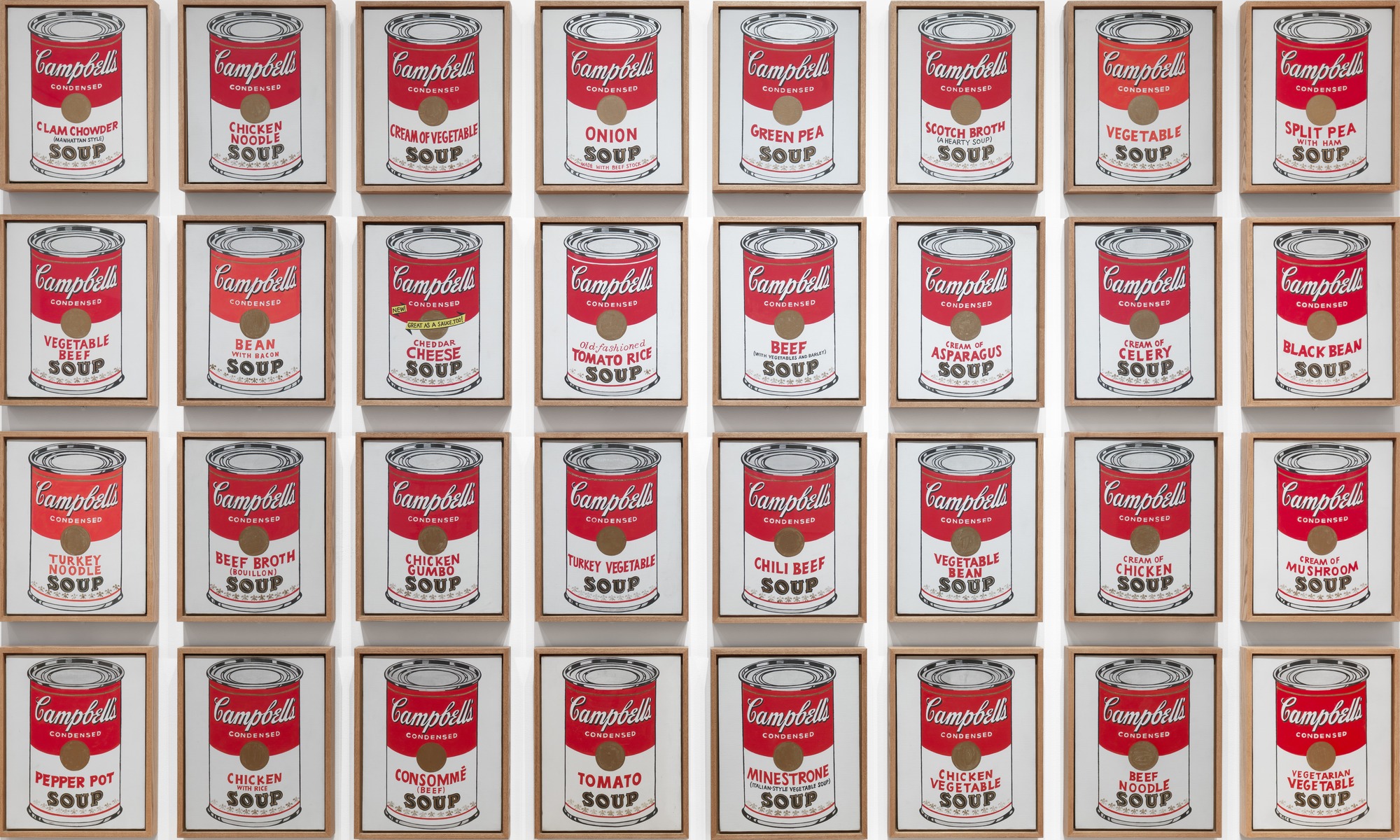
There are thirty small paintings of 32 cans of soup, one for every flavor that the Campbell's Soup Company produced in 1962.
When Warhol showed this set of paintings at a one-man show in LA, only six of the thirty-two paintings sold, at a mere $100 each. His dealer bought back those six in order to keep the set complete and paid Warhol $1,000 for the lot. Warhol's next show was canceled. Only two years later, Warhol set up the studio that would become known as "The Factory" and would make him uber-famous, driving up those prices astronomically.
This painting was very unpopular with some people because they felt it was too realistic. Abstract Expressionism was all the rage, which is ironic because when the abstract expressionists first appeared, they offended people who preferred more realistic art.
No one is 100% sure why Warhol painted Campbell's soup cans, but some theories include:
- His mother used to make flowers out of tin cans, including Campbell's soup cans.
- He was painting cartoons, but then Roy Lichtenstein made way cooler paintings of cartoons, so Warhol needed a new subject. His assistant suggested he should paint ordinary things like soup cans.
- He ate soup and drank Coca Cola for lunch every day.
Warhol had no commercial relationship with the Campbell's Soup company. Talk about great free advertising for Campbell's and a great art launchpad for Warhol!

Featured Content
Here is what Wikipedia says about Campbell's Soup Cans
Campbell's Soup Cans is a series of 32 paintings produced by American artist Andy Warhol between 1961 and 1962. Each painting depicts a different variety of Campbell's soup cans in a uniform 20-by-16-inch format. First exhibited in July 1962 at the Ferus Gallery in Los Angeles, the pop art works challenged traditional distinctions between fine art and commercial imagery. Warhol's association with the subject led to his name becoming synonymous with the Campbell's soup cans. The series catapulted Warhol to fame and contributed to critical discourse about originality, reproduction, and the meaning of art in a consumer society.
Drawing on his background as a commercial illustrator, Warhol focused on the packaging of everyday items, making high art of the artistic depiction of the commercial packaging rather than of the everyday items themselves, prompting initial controversy but eventual acclaim. The Campbell's Soup Cans series generally refers to the original 32 canvases, but it also encompasses Warhol's many subsequent variations: approximately 20 similar paintings produced in the early 1960s; a 1965 set of 20 larger multi-colored canvases; numerous related drawings, sketches, and stencils created over the years; and two separate editions of 250 ten-print screen print portfolios issued in 1968 and 1969. The original 32 canvases were preserved by art dealer Irving Blum and later acquired by the Museum of Modern Art in 1996.
Warhol's Campbell's Soup Cans are widely regarded as a canonical symbol of Pop art and one of the most influential bodies of art of the 20th century. The later sets of screen prints are sometimes confused with the original 1962 series, and unauthorized prints have also circulated. Despite this, the series has maintained a lasting presence in popular culture, inspiring derivative works by other artists and achieving multimillion-dollar results in the art market.
Check out the full Wikipedia article about Campbell's Soup Cans


